


What Is NIST-Traceable Calibration & Why It Matters for Industrial Environmental Monitoring
When environmental data is used in a regulatory filing, a legal proceeding, an aviation safety audit, or a commercial procurement dispute, the core question is never just: “Was the instrument accurate?”
The real question is: “How do you know, and can you prove it?”
This is exactly what calibration traceability is designed to answer. It is the documented, unbroken paper trail that connects your field sensor’s real-world performance directly back to an internationally recognized measurement standard. In professional meteorological, hydrological, and renewable energy monitoring, this documentation isn’t optional—it is the definitive line between data that stands up to scrutiny and data that gets disqualified.
What Is NIST-Traceable Calibration?
NIST stands for the National Institute of Standards and Technology, the U.S. federal agency responsible for maintaining ultimate national measurement standards. For weather and environmental monitoring, these standards govern the exact physical quantities your instruments measure every day: temperature, relative humidity, barometric pressure, wind speed/direction, and solar irradiance.
The Key Distinction: A “NIST-traceable calibration” does not mean that NIST personally calibrated your specific weather sensor. Instead, it means the laboratory equipment used to calibrate your sensor was verified against a higher-tier reference standard, which was verified against an even higher standard, ultimately linking back to NIST.
A calibration certificate that simply states “calibrated” without establishing this rigorous chain of custody holds virtually no weight during an audit. NIST traceability is what gives your data its legal and technical defensibility.
Anatomy of a Traceability Chain
Traceability isn’t a marketing claim; it is a strict hierarchical structure.
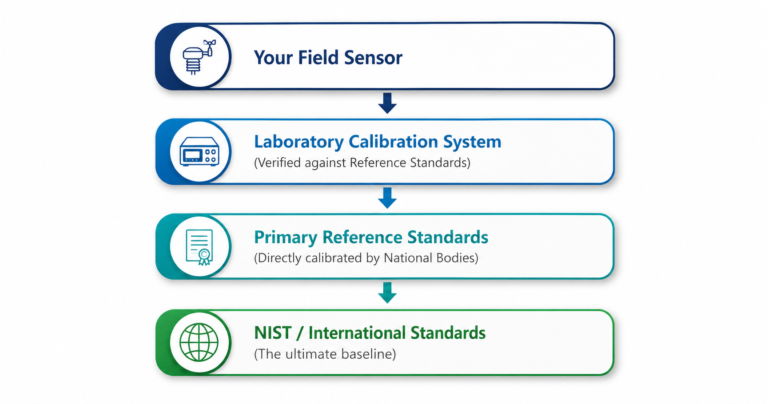
Every single link in this chain must be explicitly documented with:
- Calibration dates
- Specific serial numbers of the reference equipment used
- Measurement uncertainty values (the quantified margin of error)
Think of it as a chain of custody for accuracy. A single missing link or undocumented step completely breaks the chain, rendering the entire traceability claim invalid—regardless of how expensive or advanced the sensor is.
Why Traceable Weather Data Matters Across Key Sectors
1. Regulatory Compliance & Grid Reliability
Many industrial monitoring applications operate under strict legal frameworks. Air quality monitoring, emissions reporting, stormwater permitting, and aviation weather systems require ironclad instrument documentation. For electric utilities and renewable energy IPPs, regulators increasingly demand defensible weather data to justify storm cost recoveries, manage grid reliability, and support extreme weather mitigation strategies.
2. Audit, Insurance, and Litigation Exposure
When environmental data supports a multi-million dollar insurance claim (e.g., severe weather damage to a solar PV plant) or an environmental lawsuit, the data will be aggressively crossexamined. A valid calibration certificate creates an indisputable record of instrument health at a specific point in time. Without it, your data can easily be dismissed as hearsay or speculation.
3. Resource Assessment Integrity
In utility-scale solar and wind development, bankable resource assessment data is required to secure project financing. International auditors and lenders will not accept unverified data. NIST-traceable sensors ensure that your meteorological masts and solar stations provide data that international banks actually trust.
What Your Calibration Documentation Package Should Include
When evaluating high-grade environmental sensors or choosing a systems integration partner, you should expect a comprehensive documentation package containing three distinct elements:
| Document | What It Proves | Why It Matters |
|---|---|---|
| Certificate of Calibration & Testing | Tied to the sensor’s unique serial number and confirms testing against NIST-referenced standards. | Verifies the instrument’s accuracy and provides its specific measurement uncertainty. |
| Certificate of Conformance (CoC) | Confirms the equipment complies with all factory engineering drawings and material specifications. | Ensures the product was manufactured according to approved engineering and quality standards. |
| ISO 9001:2015 Certification | Verifies that the manufacturer’s quality management system is independently audited. | Demonstrates consistent quality control, repeatable processes, and reliable manufacturing practices. |
Addressing Sensor Drift: How Often Should You Recalibrate?
Calibration is a point-in-time snapshot. It proves an instrument was accurate on the day it left the lab, but it cannot stop the laws of physics.
All weather sensors suffer from sensor drift over time. Continuous exposure to harsh solar radiation, extreme temperature fluctuations, dust, and moisture causes mechanical wear and electronic degradation.
- The Baseline Rule: We strongly recommend a minimum of annual (12-month) recalibrations for critical industrial applications to maintain a continuous, defensible data record.
- Field-Serviceable vs. Factory Recalibration: Some mechanical or modular sensors allow for precision field-service and calibration checking using portable validation kits— minimized downtime is a massive operational asset for remote sites. Other advanced sensors (like optical pyranometers or ultrasonic anemometers) must be returned to a specialized lab for factory recalibration.
A weather sensor without a current, active recalibration record only documents its historical initial state. For modern infrastructure projects, that is simply not enough.
Pre-Procurement Checklist: Questions to Ask Your Vendor
Before deploying a sensor network for any mission-critical or commercial application, ensure your vendor can confidently answer these questions:
- Is the calibration certificate unique to the specific serial number of the sensor I am purchasing?
- Are the calibration standards explicitly stated as traceable to NIST or equivalent international bodies (like PTB or NPL)?
- Does the manufacturer hold a current, externally audited ISO 9001:2015 certification?
- Can this sensor be validated or calibrated in the field, or does it require a complete return-to-factory?
- Are engineering drawings, Modbus/SDI-12 registers, and full technical specifications readily available for integration review?
At Buraq Integrated Solutions, we engineer turnkey meteorological, hydrological, and renewable energy stations that prioritize data defensibility from day one. If you are designing an environmental monitoring network that needs to withstand strict regulatory, financial, or legal scrutiny, contact our engineering team today to discuss fully compliant, traceable instrumentation.