


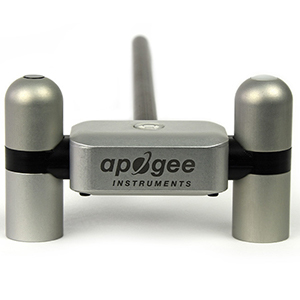
Modbus Net Radiometer (SN-522-SS)
Digital, Lowcost Net Radiometer
The SN-522-SS Modbus Net Radiometer is a high-precision four-component radiation sensor designed to measure incoming and outgoing shortwave and longwave radiation. Featuring a Modbus RS-232/RS-485 digital output, it provides accurate, reliable data while simplifying system integration with modern data loggers and environmental monitoring systems.
Specifications
| Parameter | Specification |
|---|---|
| Input Voltage Range | 5.5 to 24 V DC (heaters are optimized to run at 12 V DC) |
| Output | RS-232 or RS-485 |
| Current Draw (12 V DC Supply Voltage) | Heaters on: 72 mA; Heaters off: 13.5 mA |
| Response Time | 750 ms to digitize all detector signals |
| Heaters (Sensors Individually Heated) | 62 mA current drain and 740 mW power requirement at 12 V DC |
| Operating Environment | -50 to 80 °C; 0 to 100 % relative humidity |
| Dimensions | 116 mm length × 45 mm width × 66 mm height |
| Mass | 320 g (with mounting rod and 5 m of lead wire) |
| Cable | M8 connector (IP68 rating) to interface to sensor housing, 5 m four-conductor shielded, twisted-pair wire in Santoprene rubber jacket with pigtail lead wires |
| Manufacturing | Made in the USA |
Pyrgeometer Specifications
| Parameter | Specification |
|---|---|
| Pyrgeometer Sensitivity | 0.12 mV per W m⁻² (variable from sensor to sensor, typical value listed) |
| Pyrgeometer Calibration Factor (Reciprocal of Sensitivity) | 8.5 W m⁻² (variable from sensor to sensor, typical value listed) |
| Pyrgeometer Calibration Uncertainty | ±5 % |
| Pyrgeometer Output Range | -24 to 24 mV |
| Pyrgeometer Measurement Range | -200 to 200 W m⁻² (net longwave irradiance) |
| Pyrgeometer Measurement Repeatability | Less than 1 % |
| Pyrgeometer Long-term Drift | Less than 2 % change in sensitivity per year |
| Pyrgeometer Non-linearity | Less than 1 % |
| Pyrgeometer Detector Response Time | Less than 0.5 s |
| Pyrgeometer Field of View | 150° |
| Pyrgeometer Spectral Range | 5 to 30 µm |
| Pyrgeometer Temperature Response | Less than 5 % from -15 to 45 °C |
| Pyrgeometer Window Heating Offset | Less than 10 W m⁻² |
| Pyrgeometer Zero Offset B | Less than 5 W m⁻² |
| Pyrgeometer Tilt Error | Less than 0.5 % |
| Pyrgeometer Uncertainty in Daily Total | ±5 % |
| Pyrgeometer Temperature Sensor | 30 kΩ thermistor, ±1 °C tolerance at 25 °C |
| Pyrgeometer Output from Thermistor | 0 to 2500 mV (typical, other voltages can be used) |
| Pyrgeometer Input Voltage Requirement for Thermistor | 2500 mV excitation (typical, other voltages can be used) |
Pyranometer Specifications
| Parameter | Specification |
|---|---|
| Pyranometer Sensitivity | 0.045 mV per W m⁻² (upward-looking); 0.035 mV per W m⁻² (downward-looking) |
| Pyranometer Calibration Factor (Reciprocal of Sensitivity) | 22 W m⁻² per mV (upward-looking); 28.5 W m⁻² per mV (downward-looking) |
| Pyranometer Calibration Uncertainty | Less than 3 % at 1000 W m⁻² |
| Pyranometer Output Range | 0 to 90 mV (upward-looking); 0 to 70 mV (downward-looking) |
| Pyranometer Measurement Range | 0 to 2000 W m⁻² (net shortwave irradiance) |
| Pyranometer Measurement Repeatability | Less than 1 % |
| Pyranometer Long-term Drift | Less than 2 % per year |
| Pyranometer Non-linearity | Less than 1 % |
| Pyranometer Detector Response Time | 0.5 s |
| Pyranometer Field of View | 180° (upward-looking); 150° (downward-looking) |
| Pyranometer Spectral Range | 385 nm to 2105 nm (upward-looking); 295 nm to 2685 nm (downward-looking) |
| Pyranometer Directional (Cosine) Response | Less than 30 W m⁻² at 80° solar zenith (upward-looking); Less than 20 % for angles between 0 and 60° (downward-looking) |
| Pyranometer Temperature Response | Less than 5 % from -15 to 45 °C |
| Pyranometer Zero Offset A | Less than 5 W m⁻²; Less than 10 W m⁻² (heated) |
| Pyranometer Zero Offset B | Less than 5 W m⁻² |
| Pyranometer Uncertainty in Daily Total | Less than 5 % |
Special Features
Typical Applications
Digital Output
High Accuracy
Heated Sensors
Primary Applications
Meteorological Studies
Agricultural Research
Environmental Monitoring
Hydrological Research
Related Products
Automatic Tracking Solar Radiation Measurement System (BS200-08)
The BS200-08 Automatic Tracking Solar Radiation Measurement System is a high-performance solution for unattended solar radiation monitoring. This advanced……
Class A Digital Pyranometer with Integrated Dome Heater (MS-80SH)
The EKO Instruments MS-80SH is a next-generation, ISO 9060 Class A pyranometer designed for highly accurate solar radiation measurement. It delivers fast-response, spectrally……
Class A Pyranometer (MS-80)
The MS-80, manufactured by EKO Instruments, is a next-generation ISO 9060 Class A spectrally flat, fast-response pyranometer designed for high-accuracy……
Class B Digital Pyranometer (MS-60S)
The MS-60S Pyranometer is a high-performance ISO 9060:2018 Class B solar radiation sensor designed for precise and reliable solar monitoring in agricultural……
Class B Pyranometer (MS-60)
The MS-60 Pyranometer is a high-performance ISO 9060:2018 Class B pyranometer designed for precise measurement of global solar radiation. Featuring an analog output……
Class C Digital Pyranometer (MS-40S)
As part of EKO’s advanced S-Series pyranometer family, the MS-40S delivers dependable solar irradiance measurements while maintaining the same……

Class C Thermopile Pyranometer (SP-510-SS)
The SP-510-SS Thermopile Pyranometer is a high-precision solar radiation sensor designed for reliable shortwave radiation measurement in environmental, agricultural……
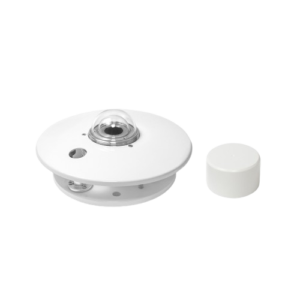
Class C Pyranometer (BS200-03)
The BS200-03 Pyranometer is designed based on the thermopile principle, utilizing electroplated, multi-contact thermopiles as its sensing element. Its surface……
4-Component Net Radiometer (CNR4)
The Kipp & Zonen CNR4 is a precision net radiometer designed for accurate measurement of the energy balance between incoming and outgoing solar and terrestrial radiation……
Solar Radiation Sensor (BS200-04)
The BS200-04 Solar Radiation Sensor is based on the silicon photovoltaic cell principle and is designed to measure solar radiation in the 300–3000 nm wave……